
Globalisation vs Nationalism — the coronavirus pandemic returns us to the nation-state
An article by Geadis Geadi from the public archive of the previous official website, preserved with its original date and complete text.
The article was hosted: - in Foreign Affairs
- in Huffington Post
- in New Economy
- in E.L.A.M. - in Reporter
Henry Kissinger, in an article in the American newspaper "Wall Street Journal" (April 3, 2020) entitled: "The Coronavirus pandemic will forever alter the world order", argues that the virus could change the state of affairs in the world forever[1].
It is obvious that the coronavirus pandemic is moving the tectonic plates of historical developments, fundamentally shaking globalization, while strengthening the role of nations and, by extension, states.
As the professor of Geopolitics at the Hellenic Academy of Sciences, Konstantinos Grivas, rightly states (in my personal opinion), at this moment “it is as if a geopolitical asteroid has hit the planet”, since it is “as if we are living together the 1918 flu, Vietnam, the financial crash of 1929 and 2008, Chernobyl, the fall of the Berlin Wall, September 11 and May 1968[2]”.
Humanity is now beginning to understand that the blind attachment to a “unified, borderless” world, as envisioned by the advocates of globalization, easily turns a regional crisis into a global one.
The coronavirus outbreak seems to be reversing the course of History, as it has shaken the credibility of both Globalization and European Unification[3], returning us back to the “era of the heroic struggle of states for national survival[4]”.
From the fantasy that considered national borders to be obsolete and that we should build a world without borders, today we have arrived at a world of strong national borders, since it seems that only the nation-state can offer security, functionality and prosperity.
The superpower games behind the pandemic
Developments since the Covid – 19 coronavirus pandemic reveal that the distrust and hostility between the United States and China have worsened[5], as a communication war has recently begun between them over who is ultimately responsible for the pandemic, further intensifying the geopolitical competition between the two.
Chinese officials have set the bar low by claiming that “the US military planted the virus in Wuhan to weaken China[6]”, with the US specifically referring to COVID-19 as the “Chinese virus” in its official announcements.
China’s expulsion of more than a dozen American journalists, “in response to the Trump administration’s moves to limit the number of Chinese citizens who can work in the United States for five Chinese state-owned news organizations to 100,” further intensifies the new Cold War between the two superpowers.
The reshaping of the international political scene and the process of “unraveling” may resemble the “unraveling” of the world that occurred with the disintegration of the Western Roman Empire,[8] which we have seen repeated in other similar cases. As was the case with the Ottoman Empire and the Soviet Union, where their collapse was accompanied by a strengthening of the national aspirations of various peoples and a shift towards “nation-states.”
The next day
The COVID-19 pandemic comes at a time of growing nationalism around the world[9], as it is evident that most nationalist movements are rapidly gaining ground in all electoral processes.
On the other hand, the rapid expansion of the population, mass migration and urbanization make the entire world vulnerable to rapidly transmitted, deadly diseases[10], while the coronavirus pandemic itself reveals the failure of international institutions as well as national governments[11], which invested with blind devotion in globalization.
Liberalization, centered on extreme privatization, where the economy is self-regulated by the “invisible hand” as economist Adam Smith states, seems to be suffering a critical blow.
The pandemic has exposed the extent of the damage caused by the “abandonment of the public sector, following a long period of neoliberalism[12]”. Today, no one dares to claim that private hospitals are better equipped to fight the virus than public ones[13].
At the same time, the head of the International Monetary Fund (IMF), Kristalina Georgieva, made a pessimistic assessment of the impact that the novel coronavirus (Covid-19) pandemic will have on the global economy. More specifically, she announced that “the pandemic will trigger a global recession this year in 2020, which could be worse than the one observed during the global financial crisis of 2008-2009[14]”.
Just to recall that in 2009, global GDP fell by 0.6%, according to IMF data. In developed economies, the decline was 3.16% and in the eurozone countries 4.08%[15].
The economic impact of the new coronavirus pandemic should not be seen as an ordinary problem that macroeconomics can solve or alleviate. On the contrary, the world could witness a fundamental change in the very nature of the global economy[16], the effects of which will be felt for decades to come[17].
The beginning of a new era
Francis Fukuyama’s argument regarding the “end of history” and his central claim that “there is no possible ideological opponent for liberal democracy”[18], today seems to be faltering.
From one end of the world to the other, the concept of the nation-state is rapidly resurfacing. “Each national government is focused on its own people, and each claims to be better prepared for the crisis than its neighbors. Essentially, overnight, national capitals have reclaimed the sovereignty they had ceded to the European Union, without the permission of either citizens or Brussels. In effect, they are governing as if they were at war, according to their own decisions.[19]”
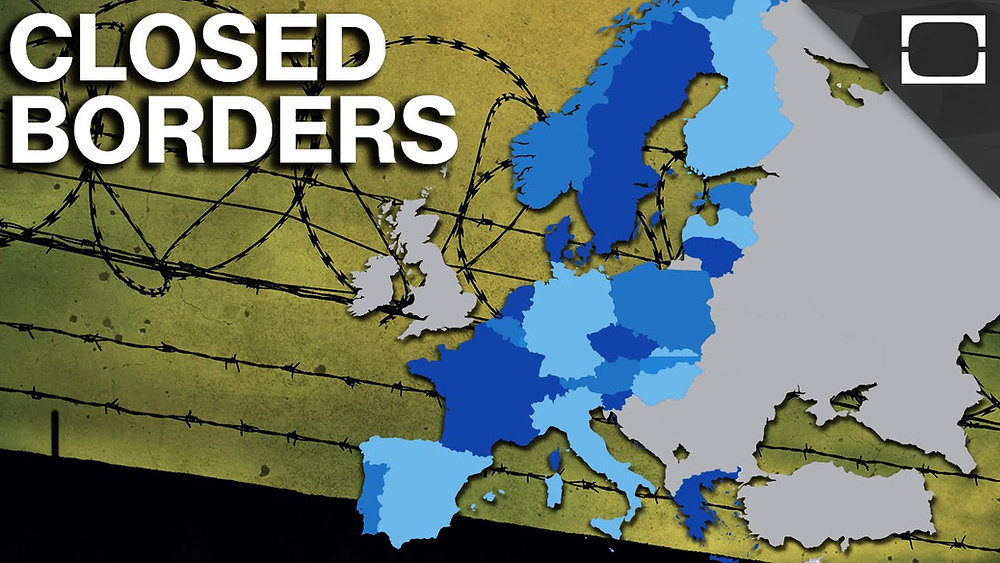
It appears that European Union states have returned to national solutions and are closing their borders to their neighbors for the first time in generations[20], despite EU officials complaining that such actions undermined solidarity and prevented the EU from adopting a common approach to fighting the new virus[21], but they have simply been ignored.
“If you can produce what you need, you can live!”
The impact on businesses, trade and markets could lead to the most devastating global economic crisis, worse than the Great Depression.[22] As the crisis continues, the ripple effects will be felt more and more, creating insurmountable obstacles to a return to the old globalized model.
Standard economic measures to address the economic impact of the coronavirus may be soothing, but it is doubtful how much they will actually improve the situation. These measures will try to provide protection for people who lose their jobs and have nothing to rely on. But when governments are confronted with the harsh reality that “people will be unable to pay their bills, creating a series of shocks, from housing evictions to banking crises[23]” and much more, they will be trapped in the impasse that their own policies have brought upon them.
Inevitably, the above will lead to a profound shift across the planet and a search for a return to the natural – that is, self-sufficient – economy. This shift is the exact opposite of globalization. While globalization contributes to the division of labor between different economies, a return to the natural economy means that nations will move towards national self-sufficiency[24].
In closing, I will borrow the words of Professor Branko Milanovic of the London School of Economics. “If you can produce your own food, if you are not dependent on electricity or water supplied by public utilities, you are not only safe from disruptions in food supply chains or in the supply of electricity and water; you are also safer from getting infected, because you are not dependent on food prepared by someone else who may be infected, nor do you need craftsmen, who may also be infected, to come and fix anything in your home. The less you need others, the safer and better off you are.[25]”
It is found that what were advantages for globalization, the crisis of the coronavirus pandemic has turned into a disadvantage, and vice versa, reinforcing the views expressed by the nationalist ideology on the effectiveness of the shift to national solutions and the importance of the existence of strong nations - states that will cooperate with respect for each other, in a new world that is being reborn.
References: [1] S. Iakovidis, The next day after the coronavirus, published by Simerini (12/04/2020) [2] K. Grivas, Coronavirus is destroying globalization, interview with Giorgos Sachini (radio 98.4) [3] J. Jielonka, The concept of the nation-state is reviving, published by Kathimerini (Greece) (27/03/2020) [4] ibid. [5] N. Burns, How to Lead in a Pandemic, 26/03/2020 [6] ibid. [7] J. Pomfret, China Will Mourn American Journalists When They Are Gone, 23/03/2020 [8] B. Milanovic, The Real Danger of the Pandemic Is Social Collapse, 20/03/2020 [9] M. Mesfin, It Takes the Whole World to End a Pandemic, 22/03/2020 [10] L. Monaco, Pandemic Disease Is a Threat to National Security, 04/03/2020 [11] L. Richardson, Universities Are Filling the Gap, 10/04/2020 [12] J. Jielonka, The Nation-State Resurgence, ed. Kathimerini (Greece) (27/03/2020) [13] ibid. [14] K. Georgieva, Press Release, IMF Managing Director Kristalina Georgieva’s Statement Following a G20 Ministerial Call on the Coronavirus Emergency, International Monetary Fund (IMF), 23/03/2020 https://www.imf.org/en/News/Articles/2020/03/23/pr2098-imf-managing-director-statement-following-a-g20-ministerial-call-on-the-coronavirus-emergency [15] IMF: Global economic recession worse than 2009 due to coronavirus, Alphanews.live (24/03/2020) [16] B. Milanovic, The real danger of the pandemic is social collapse, 20/03/2020 [17] Mohamed A. El-Erian, The coming recession due to coronavirus, 18/03/2020 [18] A. E. Casey & Seva Gunitsky, The Weakness of the Authoritarian, 02/04/2020 [19] J. Jielonka, The Nation-State Resurgence, Kathimerini (Greece) (27/03/2020) [20] N. Burns, How to Lead in a Pandemic, 26/03/2020 [21] European Commission warns member states on mask export ban, Financial Times [22] N. Burns, How to Lead in a Pandemic, 26/03/2020 [23] B. Milanovic, The Real Danger of the Pandemic is Social Collapse, 20/03/2020 [24] ibid. [25] ibid.
Geadis Geadi