
Bitter “vanished” truths about the betrayal of Cyprus
An article by Geadis Geadi from the public archive of the previous official website, preserved with its original date and complete text.
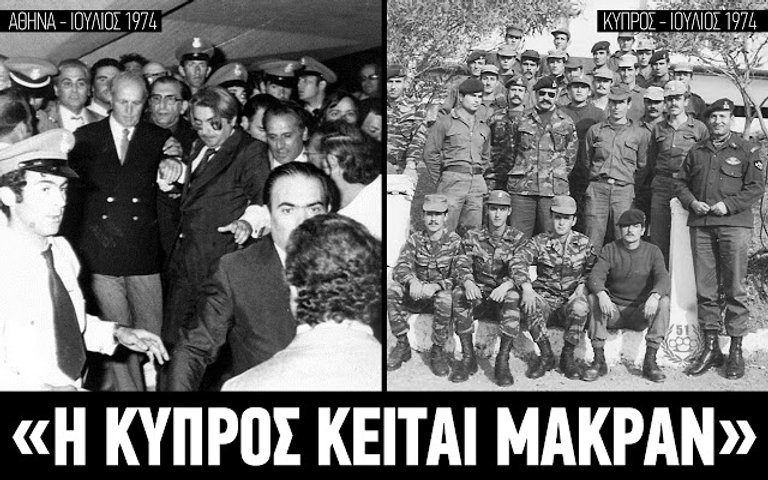
The article was hosted in the newspaper Simerini
From deep sleep, I am suddenly awakened by the sound of sirens. It was still a hot day of summer, the dark period for our Cyprus. It was July 20th.
5:30 am. Thoughts race and take me to the past at the speed of light, like the rays of the sun that tear through the shutters and penetrate the room when it rises.
They do not leave me in the present but pull me by the hand and take me far away, on a crazy journey back in time. I swim, between the sheets of ships, to the shores of "Five Miles". I follow them and they take me out into the shallows. Then, boots around me, they forcefully trample the sea and break its beautiful peace. Resistance is minimal. Everything seems betrayed. I transform and fly over Cyprus, which has been turned into a cemetery. I see the living dead. Corpses everywhere, which had the unique property of changing position and side. The July heat was swelling, inflating the corpses and that is why they moved around, with their tongues out, as if they were mocking us, according to the gruesome testimony of a Turkish journalist. According to him, most of the murders were committed by Turkish “Cypriots”, those whom today various people present as brothers, who, as another Kurdish comrade-in-arms states, had no moral barriers.
The gruesome images slap my mind and I return to the present. I run to the library and leaf through some old books and newspapers that I dug up in antique shops. I identify certain statements and facts that are deeply buried, so that the people do not know:
- In the Newspaper "Milliet", June 14, 1976, in an interview with the director of Ipeksi, who asks "However, I want to point out the following: Our first intervention in Cyprus was legal", the State Deputy of the New Democracy Eleni Vlachou answers affirmatively "yes".
- Rallis, Minister of Foreign Affairs of the Karamanlis Government (as published in the newspaper "To Vima", May 11, 1979), in response to Ecevit's speech to the Council of Europe, May 10, 1979:
"As far as the invasion of Cyprus is concerned, it is worth noting that Turkey launched not one, but two military operations against the island. If the first of these operations could be explained by the arguments invoked by Mr. Ecevit, the second was unjustified from every point of view. Because in August 1974, legality had already been restored both in Cyprus and in Greece, in the persons of Clerides and Karamanlis respectively.”
- Karamanlis, in a letter to Demirel, May 19, 1976, as published in the newspaper “Kathimerini” on the 23rd of the same month, writes: “On July 20, 1974, Turkey invaded Cyprus, taking advantage of the coup against Makarios and claiming that the purpose of the intervention was the restoration of legality. However, legality was restored after 3 days in Cyprus in the person of Clerides and in Greece with my return. The purpose, therefore, of the Turkish intervention had been fulfilled and logically Turkey should have withdrawn its troops from Cyprus”.
- Evangelos Averof, in an interview with the magazine “Epikaira”, March 25, 1978, states with the unspoken satisfaction of a prophet: “In all my letters to Karamanlis I told him: Do not believe anything they tell you. The military regime does not fall easily. Only with a national calamity will they fall. If the tragedy of Cyprus had not happened, they would not have fallen easily”.
- Evangelos Averof, later in the Turkish newspaper “Sabah”, appeared more eloquent. As reported by "News", on November 1, 1986, he said: "You were right to make the first landing in Cyprus to protect the Turks. But there was no need for the second. Don't forget that at that time there was a Junta. The first landing was a good lesson to our people, the fanatical Greeks".
- Eleni Vlachou, publisher of the Greek newspaper "Kathimerini" and a state MP for the New Democracy, on July 21, 1974 at 6 p.m. declared to the English BBC station, "that the Turkish invasion was a police operation, and that after the restoration of constitutional order, the Turks will leave!" While continuing, he said: "I am not against the Turks, but against the Greek Junta".
- In an interview with the newspaper "O Agon" on April 24, 1979, the head of the Cyprus Security Service, Toumbazos, who is perhaps the most competent person to give us the most authoritative information, states that: "The Cypriot leadership knew and expected a coup. It knew that a Turkish invasion would follow at the same time." Hence his recommendation to his family, who were vacationing in Kyrenia: "If a coup occurs, return immediately to Nicosia, because a Turkish invasion will follow." Toumbazos made another surprising revelation, that EOKA B did not know that a coup would take place!
After the above, I would like to raise some questions, such as why Karamanlis kept the same leadership in the armed forces, since it was not only responsible for the coup against Makarios, but also demonstrably incapable of fulfilling its duties, as it appeared during Attila 1? Why did he subsequently issue Presidential Decree 519 on July 29, 1974, which granted amnesty to the junta members? Why from July 24 to August 14, 1974, unlike the Turks, not a single cartridge was sent to Cyprus! While on August 15, Karamanlis declared that: “Cyprus lies far away and we cannot help it.”
And why did the Council of Ministers, in April 1975, prohibit an investigation into the coup and the Turkish invasion, with the excuse that this was imposed by "national reasons"? What are these reasons? What are they afraid of and what are they hiding?
Unfortunately, I conclude that Greek politicians not only tolerated "Attila I", but helped to bring it about, in order to ascend to power, while they themselves considered Attila II to be outside the rules of the game. Cyprus was sold in order to bring so-called democracy to Greece, this is the bitter truth, which is why no one really demands that the Cyprus file be opened, except for the Greek nationalists. It is time to finally find out who the traitors are and who the ethnarchs are...
Geadis Geadi